August 19, 2026
Where to Recycle in Dubai: Drop-Off Locations...
A recycled bottle at the office, a stack of cardboard at home,...

The world is rethinking the way it produces, consumes, and discards. Old habits built on a “take, make, dispose” model are no longer sustainable, and countries that once depended heavily on resource extraction are now building systems designed to keep materials in use for as long as possible. The UAE sits at the center of this transformation, and understanding why starts with a clear look at what a circular economy actually means and what is making the Emirates one of the most ambitious adopters of this model in the world.
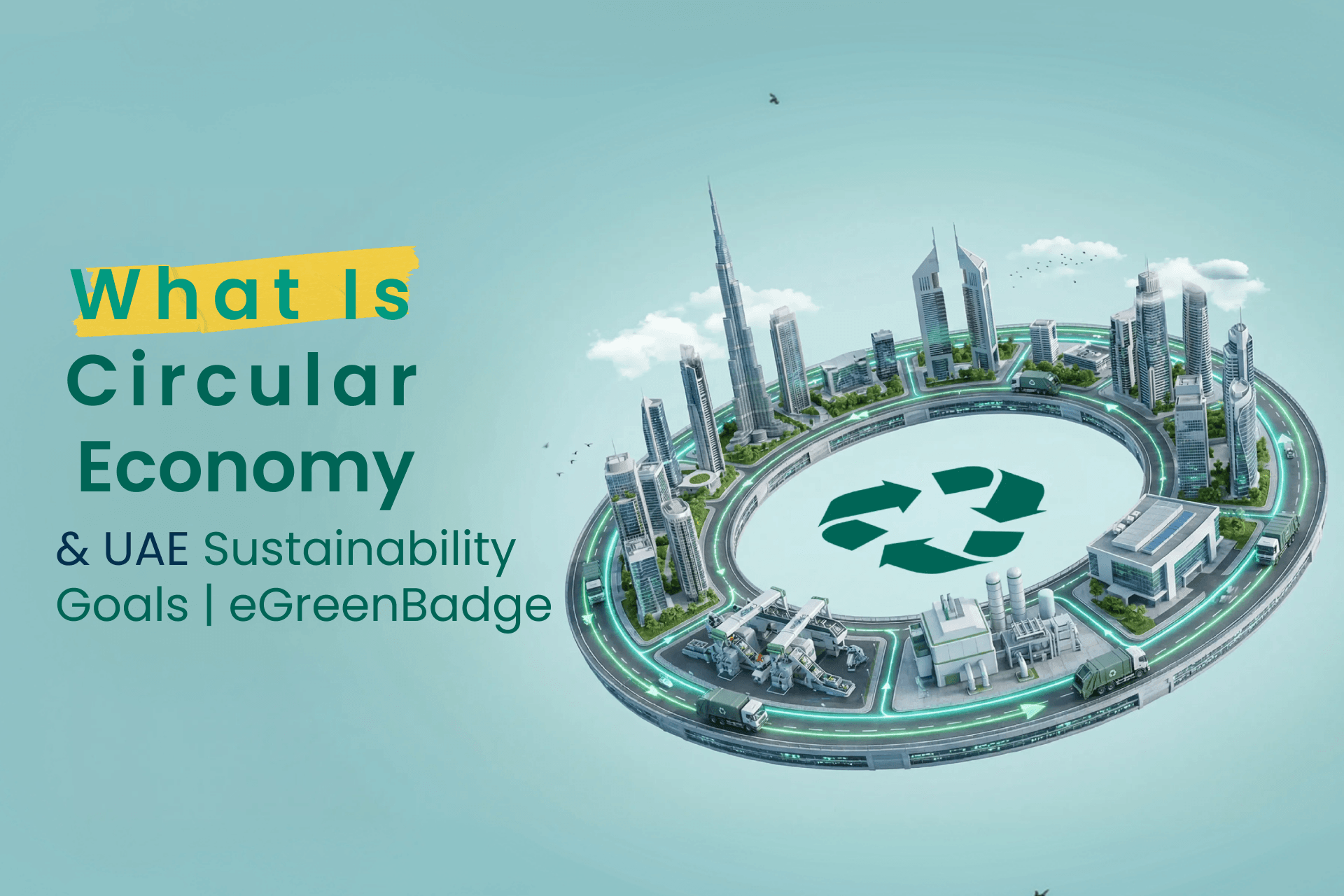
A circular economy is an economic system designed to eliminate waste by keeping products, materials, and resources in use for as long as possible. Unlike the traditional linear economy, which follows a straight line from production to consumption to disposal, the circular model forms a closed loop. Products are designed to be:
This allows the materials inside them to stay productive rather than ending up in a landfill.
The concept rests on three main principles:
A circular economy is not simply about recycling more. It is about rethinking how things are made and how value is created at every stage of a product’s life. That distinction matters because recycling alone does not address overproduction or the extraction of raw materials.
Instead, the circular model challenges the entire chain, including:
By reducing waste and maximizing resource efficiency, circular economy practices help businesses and governments build more sustainable and resilient systems for the future.
The linear economy is built on volume. More production equals more growth. Waste is treated as an unavoidable byproduct of doing business. The circular economy treats waste as a design flaw and turns it into a starting point for value creation. A company operating within a circular framework might lease its products rather than sell them, take them back at end of life, refurbish them, and put them back into the market. The same physical material generates economic value repeatedly instead of once.
This shift has direct benefits for businesses, governments, and communities. It reduces dependence on raw material imports, creates jobs in repair and recycling sectors, lowers the cost of waste management and significantly reduces the environmental footprint of industries that have historically been among the heaviest polluters.
Understanding how this works in practice makes the concept easier to grasp and helps businesses and individuals see where they fit in the picture.
One of the clearest circular economy examples in manufacturing is the move toward designing products that can be taken apart, repaired, and rebuilt. Electronics manufacturers are increasingly building devices with modular components that can be replaced individually rather than discarding an entire product when one part fails. In the UAE, the Ministry of Industry and Advanced Technology has been pushing policies on using recycled materials in consumer goods, which directly changes how manufacturers source inputs and handle post-consumer products.
In the food sector, circular principles mean reducing food waste at every stage of the supply chain, converting organic waste into compost or biogas, and designing supply chains that recover value from byproducts. The UAE’s Food Economic Cluster is an active example of embedding circular logic into national food strategy, integrating production, processing, and distribution into a system designed to minimize losses and maximize resource efficiency.
Buildings consume enormous quantities of materials, and most demolition waste ends up in landfills. The circular approach to construction means designing buildings for disassembly so that structural materials can be salvaged and reused; using recycled aggregates in new construction; and adopting prefabrication methods that minimize on-site waste. Abu Dhabi has set compliance targets requiring all sectors to align with circular economy standards, with the plastics manufacturing sector having a full compliance target already in place.
Perhaps the most visible application of circular thinking is the idea of waste to value in the UAE, which transforms materials that would otherwise be discarded into productive inputs. Construction and demolition waste is being processed and converted into recycled aggregates used in new building projects. Non-recyclable waste is being converted into alternative fuel that reduces reliance on fossil fuels in cement and other industries. Facilities across the country handled over a million tonnes of waste in 2024 alone, redirecting those materials away from landfills and back into productive use.
The UAE’s commitment to a circular economy is not a corporate trend or a marketing message. It is national policy, backed by legislation, institutional structures, and measurable targets.
The foundation was laid with the UAE Circular Economy Policy issued in 2021, which established a comprehensive framework for transitioning the national economy away from linear consumption patterns. The policy focused on four priority sectors: sustainable manufacturing, sustainable infrastructure, sustainable transportation, and sustainable food production and consumption. These sectors were chosen because of their combined weight in the national economy and their potential to drive the widest impact.
In March 2023, the UAE Cabinet adopted the UAE Circular Economy Agenda 2031, which took the original policy and turned it into an action plan with 22 specific policies and clear timelines. This agenda serves as the implementation framework that guides both federal and local government decisions and invites the private sector into an active role.
The UAE Circular Economy Council, chaired by the Minister of Economy and Tourism, meets regularly to track progress, review new policy proposals, and ensure that federal and local strategies stay aligned. In 2025, the council held multiple meetings focused on accelerating the second batch of circular economy policies, targeting areas such as sustainable transportation, clean industries, and biofuel production. The council is also focused on growing private sector involvement and expanding partnerships that bring innovation and capital into the transition.
The national objective is clear: position the UAE as a global hub for circular economy practices, contributing to the broader goals of the “We the UAE 2031” vision and supporting the country’s Net Zero by 2050 commitment.
Dubai has become one of the most active cities in the region when it comes to putting circular economy principles into practice. The Dubai Integrated Waste Management Strategy 2021 to 2041 sets a bold target of achieving zero waste to landfill by 2041. This is not a symbolic goal. It is backed by specific infrastructure investments, technology deployments, and community programs designed to divert, sort, recover, and recycle everything the city generates.
One of the most significant recent developments in circular economy in Dubai is the launch of Circle Dubai, introduced during the 2025 Asia-Pacific Cities Summit. The initiative is built around the vision of a landfill-free city and sets a target of 100 percent diversion of waste from landfills, with at least 56 percent of that waste being recycled. Circle Dubai combines smart technology, community education, and policy reform to change how residents, businesses, and institutions manage the materials that pass through the city.
Material recovery facilities across Dubai and the wider UAE are already capable of recovering significant portions of municipal solid waste and converting it into high-grade recyclable materials. Waste-to-energy projects in Dubai, Abu Dhabi, and Sharjah are designed to generate over 140 megawatts of electricity from processed municipal solid waste, reducing dependence on fossil fuels while eliminating landfill pressure.
The single-use plastics ban that both Dubai and Abu Dhabi have implemented is another concrete sign of circular policy in action. Removing these materials from the supply chain entirely is the highest-level circular strategy: designing waste out of the system before it ever enters.
The zero waste goal in the UAE is not exclusive to Dubai. Abu Dhabi has its own zero-waste targets, and the commitment runs across all seven emirates. Under UAE Vision 2021, the country set a target of reducing landfill-bound waste by 75 percent. These ambitions have since evolved into more detailed, sector-specific plans that address not just how waste is managed but how it is generated in the first place.
The concept of zero waste in the UAE goes beyond collection and sorting. It asks businesses to redesign their operations, asks consumers to change buying habits, and asks governments to create the regulatory conditions where circularity is the default rather than the exception. The UAE has created the Blue Visa program, offering a 10-year residency permit for individuals who actively contribute to environmental sustainability, signaling that the country views environmental commitment as a form of social and economic value.
Companies across the country are increasingly viewing waste as a resource rather than a cost. Investments in recycling, recovery, and treatment technologies are growing because businesses understand that the regulatory environment is tightening and that those who build circular capabilities now will be better positioned as compliance requirements expand. The government is meeting this momentum with incentives, initiatives, and platforms that make the transition easier and more commercially viable.
Several factors make the UAE uniquely suited to become a global leader in the circular economy transition.
The first is leadership. The UAE’s government has made sustainability a national identity, not just a policy priority. From COP28 hosted in Dubai in 2023 to the active work of the UAE Circular Economy Council in 2025, there is consistent, high-level political will behind the agenda. That kind of leadership creates the conditions for bold regulatory action, significant investment, and the cross-sector coordination that a genuine economic transformation requires.
The second is infrastructure ambition. The UAE has consistently shown a willingness to invest heavily in physical infrastructure, and this extends to sustainability. Waste-to-energy plants, material recovery facilities, smart recycling systems, and industrial parks designed around circular principles are all part of the landscape that is being built right now.
The third is the private sector ecosystem. Over 56,000 companies and commercial licenses were operating in new economy sectors in the UAE by the first half of 2025, many in areas directly tied to sustainability, clean technology, and advanced manufacturing. This creates the commercial energy to test, scale, and export circular solutions.
The fourth is strategic vision. The UAE’s circular economy agenda is embedded within its broader economic diversification strategy, its Net Zero by 2050 commitment, and its ambition to be a global hub for innovation. A circular economy is not a side project; it is a pillar of the national future.
Understanding what a circular economy is and what the UAE is doing to build one is the first step. The next is knowing how to participate.
For businesses, the shift involves auditing how materials flow through operations, identifying where waste is generated, and looking for opportunities to close loops. This might mean switching to suppliers that offer take-back programs, redesigning packaging to use recycled content, adopting service-based business models where appropriate, or partnering with facilities that can convert industrial byproducts into useful inputs. The UAE’s regulatory direction is clear, and the companies that start adapting now will face fewer compliance costs and more commercial opportunities as the policies tighten.
For individuals, circular participation often starts at home with sorting, reducing food waste, choosing products designed to last, and supporting businesses that operate responsibly. Small habit changes, when adopted across a city and a nation, translate into meaningful reductions in landfill pressure and resource consumption.For organizations looking to formalize their commitment and demonstrate it credibly, the circular economy creates an opportunity to align operations with both national policy and global sustainability standards. Learn how a circular economy turns waste into value and how your organization can build a measurable sustainability identity that goes beyond compliance and into genuine contribution.
The circular economy is not a future scenario. It is being built right now, in the policies being passed in Abu Dhabi, in the facilities being constructed across Dubai, in the companies rethinking their supply chains, and in the communities changing how they sort and manage the materials they use every day.
The UAE has chosen to lead this shift with intent and investment. As the Circular Economy Agenda 2031 moves through its implementation phases and the zero-waste targets get closer, the question for every business and institution operating in the UAE is not whether to engage with this transition but when and how. The infrastructure, the policy framework, and the commercial opportunity are already in place. What comes next depends on how many organizations decide to build circular thinking into the way they operate, not as a compliance exercise but as a genuine strategy for long-term value.